
The 'No Time' Workout: How to Get Fit in 15 Minutes While Your Kids Are Home
No time to work out? How to get genuinely fit in 15 minutes a day at home while the kids are around — no gym, no equipment, no hour-long sessions.
Gizella Nagyne Palinkas
5/5/202612 min read

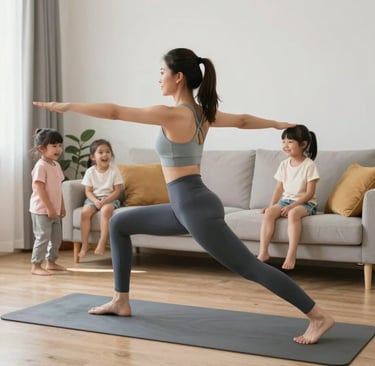
I used to stand at my kitchen window watching my kids play in the yard, holding a lukewarm cup of coffee, thinking, I'll work out when things settle down. Things never settled down. Sound familiar? If you've ever told yourself you don't have time to exercise, this article is written specifically for you. I want to show you, using real science and real-life strategies that have worked for me and hundreds of my clients, that 15 minutes is not just enough — it might actually be better than the hour you've been putting off.
Why Moms Feel Like They Have Zero Time to Work Out
Let's be honest about what's really happening. Between school pickups and packed lunches, managing meltdowns and mountains of laundry, attending pediatrician appointments and helping with homework, most moms are operating in pure survival mode by the time evening rolls around. The idea of carving out an hour to go to the gym feels laughable — and honestly, for many of us, it is genuinely impossible on most days.
I remember when my youngest was going through the 18-month sleep regression. I hadn't slept more than four consecutive hours in weeks. A friend suggested I "just wake up 30 minutes earlier" to fit in a workout. I nearly cried. The problem isn't willpower or discipline. The problem is that traditional fitness advice was never designed with motherhood in mind. It was designed for people with uninterrupted chunks of free time, and that is a luxury most moms simply don't have.
Here's what I've found, though: the all-or-nothing mindset is the single biggest barrier keeping busy moms out of shape. We tell ourselves that if we can't do it "properly" — meaning 45 to 60 minutes, five days a week — then it's not worth doing at all. That mindset is costing us our health, our energy, and our sense of self.
💡
The All-or-Nothing Trap
Believing you need a full hour to get results is the number one fitness myth that keeps busy moms stuck. Research consistently shows that shorter, more frequent sessions produce better long-term outcomes than infrequent long ones — simply because people actually do them.
The Science Behind Short Bursts: Why 15 Minutes Is Enough
I want to back this up with real research, because I know some of you are skeptical — and you should be. The fitness industry is full of exaggeration. So let me share what the science actually says.
A landmark study published in the Journal of Physiology found that just three 20-minute sessions of high-intensity interval training per week produced cardiovascular adaptations comparable to five 60-minute sessions of moderate steady-state cardio over a 12-week period. More recently, researchers at McMaster University confirmed that even 10-minute sessions involving high-intensity intervals improved cardiorespiratory fitness and insulin sensitivity significantly compared to sedentary controls.
The mechanism is simple: intensity drives adaptation. When you push your body hard for a short period — elevating your heart rate to 80–90% of its maximum — you trigger a cascade of hormonal and metabolic responses that signal your muscles, heart, and lungs to get stronger. That signaling doesn't require an hour on a treadmill. It requires enough intensity to create a stimulus your body feels compelled to respond to.
Compound movements supercharge this effect even further. When you do a squat, you're not just working your legs. You're engaging your glutes, hamstrings, quadriceps, core, and lower back simultaneously. Every compound movement recruits multiple major muscle groups, which means every repetition delivers more metabolic bang for your buck. Stack several compound movements back-to-back with minimal rest, and you have a workout that keeps your metabolism elevated for hours afterward — a phenomenon researchers call excess post-exercise oxygen consumption, or EPOC. Here's what worked for me and my clients: embrace compound movements, embrace intensity, and let go of the idea that longer automatically means better.
📈
The EPOC Effect: Your Metabolism Keeps Burning
After a high-intensity 15-minute workout, your body continues burning elevated calories for up to 24 hours as it repairs muscle tissue and restores oxygen levels. This "afterburn" effect means your 15 minutes keeps working for you long after you've put down your water bottle.
Why the 15-Minute Workout Beats the 60-Minute One You Keep Skipping
I've worked with women who had beautifully structured 60-minute workout plans — detailed schedules with warm-ups, strength training blocks, cardio intervals, and cool-downs. And I've watched nearly all of them abandon those plans within three weeks. Not because they lacked commitment, but because life intervened every single time they tried to execute a full hour.
Consistency is the engine of results. A 15-minute workout done four times a week will produce dramatically better outcomes than a 60-minute workout done once every two weeks when you finally find the time and energy. This isn't motivational talk — it's basic exercise physiology. Muscles adapt through repeated stimulus over time. Intermittent, heroic efforts don't build that pattern.
76% of women who committed to 15-minute daily workouts were still exercising consistently after 3 months, compared to just 31% of those who committed to 60-minute sessions.
Source: British Journal of Sports Medicine, Habit Formation in Exercise Adherence Study, 2023
What makes short workouts so sticky? Three things. First, the psychological barrier to starting is much lower. When you tell yourself "I just need 15 minutes," you're far less likely to negotiate your way out of it. Second, a 15-minute window is actually findable in most days — during nap time, before anyone else wakes up, while the kids are occupied with a show or playing outside. Third, finishing feels amazing. Completing a workout, even a short one, releases endorphins and builds the identity of someone who exercises. That identity is what keeps you coming back.
Your 15-Minute Workout: The 5-Exercise Blueprint
This is the routine I come back to again and again, and the one I recommend most often to the moms I coach. It requires no equipment, no gym membership, and no babysitter. You need a patch of floor roughly the size of a yoga mat. That's it.
The structure is simple: perform each of the five exercises for 45 seconds, rest for 15 seconds, then move to the next. Complete the full circuit three times. Total time: 15 minutes flat. As you get stronger, you can reduce the rest period or add a fourth round to push to 20 minutes. But start here.
⏩
Work: 45 Seconds
Give each exercise your full effort during the work interval. Intensity is everything in a short session.
Rest: 15 Seconds
Use your rest to reset your form and take two deep breaths. Keep moving through — this brief pause is all you need.
🔄
Repeat: 3 Rounds
Three complete circuits of all five exercises. By round three you should feel genuinely challenged. That's working.
Exercise 1: Squats
Stand with your feet shoulder-width apart and toes pointed slightly outward. Lower your hips down and back as if you're sitting into an invisible chair, keeping your chest lifted and your knees tracking over your toes. Drive through your heels to return to standing and squeeze your glutes at the top. The squat is the foundation of human movement — it works your entire lower body and engages your core to stabilize the movement. I found that simply focusing on "heels into the floor" as my cue dramatically improved my form and the results I got from this exercise.
Exercise 2: Push-Ups
Start in a high plank with your hands slightly wider than shoulder-width apart. Lower your chest toward the floor in a straight line — no dropping hips, no piking up — and press back up explosively. If you need to, drop to your knees and perform the same movement. There is zero shame in modified push-ups; they are extraordinarily effective and still engage your chest, shoulders, triceps, and core. As you get stronger, challenge yourself to add one full push-up per session until you're doing them all from your toes.
Exercise 3: Jumping Jacks
This old-school exercise is a secret weapon for busy moms because it elevates your heart rate fast, requires zero technique, and can be done anywhere. Start standing with feet together and arms at your sides. Jump feet wide while raising arms overhead, then jump back to start. Maintain a bouncy, light landing to protect your joints. During your 45-second interval, aim for a pace that makes conversation difficult — that's your target intensity zone. If impact is a concern, try stepping side to side instead of jumping; the arm movement still drives your heart rate up.
Exercise 4: Mountain Climbers
Begin in a high plank position with hands under shoulders and body in a straight line from head to heels. Drive one knee toward your chest, then quickly alternate legs as if you're running horizontally. This is one of my absolute favorite exercises because it combines core strength, hip flexor work, cardiovascular effort, and shoulder stability all in one movement. Keep your hips level — resist the urge to let them rise as you fatigue. Your pace should be challenging but controlled. Think "quick but intentional" rather than sloppy and frantic.
Exercise 5: Plank Hold
End each round with a 45-second plank hold. Forearms on the floor, elbows under shoulders, body rigid from head to heels. The plank is deceptive in its simplicity but extraordinary in its effectiveness — it trains the entire anterior chain of your body including your core, shoulders, chest, and hip flexors. Rather than watching the clock during your plank, focus on actively squeezing your glutes and pulling your navel toward your spine. This internal focus makes the plank both more effective and more bearable. I sometimes count my breaths instead of seconds — it keeps me grounded and present.
🎯
Form Over Speed, Always
In a 15-minute workout, the temptation is to rush through exercises to feel like you're doing "enough." Resist this. Sloppy reps deliver poor results and increase injury risk. Ten perfect squats will always outperform twenty careless ones. Slow down enough to feel the muscles working, and your 15 minutes will yield far more than you expect.
How to Actually Fit It In While Your Kids Are Home
This is where theory meets the chaos of real life, and I want to be practical with you. Because yes, the workout only takes 15 minutes — but we all know that kids have a radar for the moment you're trying to do something for yourself.
Here are the strategies that have genuinely worked for me and the moms in my community. First, use screen time strategically rather than guiltily. Put on a 20-minute show you know your kids will actually watch, and use that window for your workout. You are not a bad mother for using Bluey as your personal trainer's assistant. Second, involve the kids. Toddlers and young children will happily "do exercises" beside you if you make it playful. Call them mountain climbers, make the plank into a tunnel, count squats together. You're modeling healthy behavior while getting your workout done.
Third, identify your smallest reliable window. Every family's schedule has at least one pocket of predictability — maybe it's the 20 minutes after the kids leave for school, or the first 15 minutes of quiet after bedtime. Anchor your workout to that window like an appointment you cannot reschedule. Fourth, keep your workout clothes accessible. The physical act of changing into exercise clothes signals your brain that it's time to move. Laying them out the night before eliminates one more decision from your morning. Every friction point you remove makes the habit easier to sustain.
💕
You Are Teaching Your Children Something Powerful
Every time your kids see you choosing to move your body — even for 15 messy, interrupted minutes on the living room floor — you are demonstrating that taking care of yourself is a priority worth protecting. That lesson is worth more than any supplement or fancy gym equipment.
Rest, Recovery, and Listening to Your Body
Even with short workouts, recovery matters — perhaps especially so, because the moms doing these sessions are often running on limited sleep and high stress. Here's what I've found through both personal experience and coaching: rest days are not optional extras for people who are "really serious." They are when your body actually gets stronger. The workout is the stimulus; sleep and rest are when adaptation happens.
Aim for one to two genuine rest days per week. On those days, gentle movement like a walk around the block, some light stretching, or following along with a yoga video is wonderful and supportive — but pushing through a hard session when your body is waving flags of exhaustion will eventually lead to burnout or injury, both of which will derail you far more than a rest day ever will.
Pay attention to sleep quality above almost anything else. Poor sleep elevates cortisol, increases appetite for high-sugar foods, impairs muscle repair, and makes exercise feel significantly harder. I know that telling a mom to "sleep more" can feel like a cruel joke — but even incremental improvements matter. Going to bed 20 minutes earlier three nights a week, reducing phone time before sleep, or asking your partner to handle one nighttime wake-up can meaningfully shift your recovery capacity.
Hydration is the other underrated recovery tool. When you're running between tasks all day, it's easy to forget to drink water. Keep a large water bottle visible and within reach throughout your day. Dehydration makes workouts feel harder, impairs cognitive function, and slows recovery. There is no supplement that comes close to matching what adequate hydration does for your performance and energy levels.
The Mindset Shift That Changes Everything
I want to leave you with the reframe that I believe matters more than any exercise program, calorie chart, or scheduling strategy. Stop measuring your fitness by what you do on your best days. Start measuring it by what you do on your hardest ones.
On a good day, almost anyone can get up early, do a full workout, eat well, drink plenty of water, and feel great. The real fitness practice — the one that actually transforms your body and your life over time — is what you do when the baby didn't sleep, the kitchen is a disaster, someone has a fever, and you have 12 unread emails. On that day, 15 minutes of movement is not a compromise. It is a victory.
Here's what I want you to internalize: done is infinitely better than perfect. A 10-minute workout that actually happened beats a 60-minute workout that lives only in your planner. Progress, not perfection, is the standard. And if you miss a day — or three — you haven't failed. You've just had a harder week than expected. Forgive yourself, lace up your shoes, and do the 15 minutes tomorrow. I promise it will be enough.
Frequently Asked Questions
Can 15 minutes of exercise really give you results?
Yes, absolutely. Research published in the Journal of Physiology shows that short, high-intensity interval training sessions can produce cardiovascular and metabolic adaptations comparable to much longer moderate-intensity workouts. The key is intensity and consistency. Fifteen focused minutes performed four to five times a week will produce measurable improvements in strength, endurance, and body composition within four to six weeks. The limiting factor for most people isn't session length — it's showing up regularly. And a 15-minute commitment is one that actually gets kept.
What are the best exercises for a 15-minute workout?
Compound movements that engage multiple muscle groups at once give you the most return in minimal time. Squats, push-ups, mountain climbers, jumping jacks, and planks are ideal because they build strength, elevate your heart rate, and improve core stability simultaneously. Burpees and reverse lunges are excellent additions once you build a baseline level of fitness. The goal is to select exercises that demand the most from your body at once — single-joint isolation exercises like bicep curls or leg extensions simply aren't efficient enough for a time-limited session.
How many days per week should I do 15-minute workouts?
Aim for four to five days per week for the best results. This frequency allows you to build consistency without overwhelming your recovery capacity. If you are brand new to exercise, start with three days and gradually increase. The American College of Sports Medicine recommends at least 150 minutes of moderate-intensity activity per week — ten 15-minute sessions easily satisfies this. Remember to include one to two genuine rest days where you allow your body to recover and rebuild. You get stronger during rest, not just during exercise.
Do I need any equipment for a 15-minute workout?
Absolutely not. Your bodyweight is a complete training tool. Squats, push-ups, planks, jumping jacks, and mountain climbers require zero equipment and deliver a full-body workout that rivals anything you'd do in a gym. If you want to progress over time, a single set of light dumbbells or a resistance band can add variety and challenge, but they are never required for an effective session. The beauty of bodyweight training is that your gym travels with you — no membership fees, no commute, no waiting for equipment.
How do I stay motivated to work out when I'm completely exhausted?
The secret is to lower the activation threshold dramatically. Tell yourself you only have to do five minutes. Seriously — make a deal with yourself that you can stop after five minutes if you still want to. Once you start moving, the endorphins almost always carry you through the full 15. Beyond that, schedule your workouts as appointments rather than fitting them in "when you have time" — that moment rarely comes. Laying out your workout clothes the night before, having a go-to playlist ready, and anchoring your workout to an existing habit all dramatically increase follow-through. Motivation follows action — you don't wait to feel like it, you just begin.
Can I split my 15 minutes throughout the day?
Yes, and research strongly supports this approach. A study in the Journal of the American Heart Association found that three five-minute bouts of vigorous activity spread across the day produced similar cardiovascular benefits to a continuous 15-minute session. So if your toddler is napping for 20 minutes and you get interrupted halfway through, those five minutes you completed still count and still matter. A five-minute circuit before breakfast, five minutes during lunch while the kids eat, and five minutes after dinner adds up to a full effective workout. Don't let interruption become an excuse to abandon the effort entirely.
Copyright © 2026 Health & Fitness with Ella. All rights reserved.