5 Bodyweight Exercises You Can Do While Your Coffee Brews
If you've ever told yourself you don't have time to work out, I want you to do the math on the next four minutes of your life.
Gizella Nagyne Palinkas
5/16/202618 min read
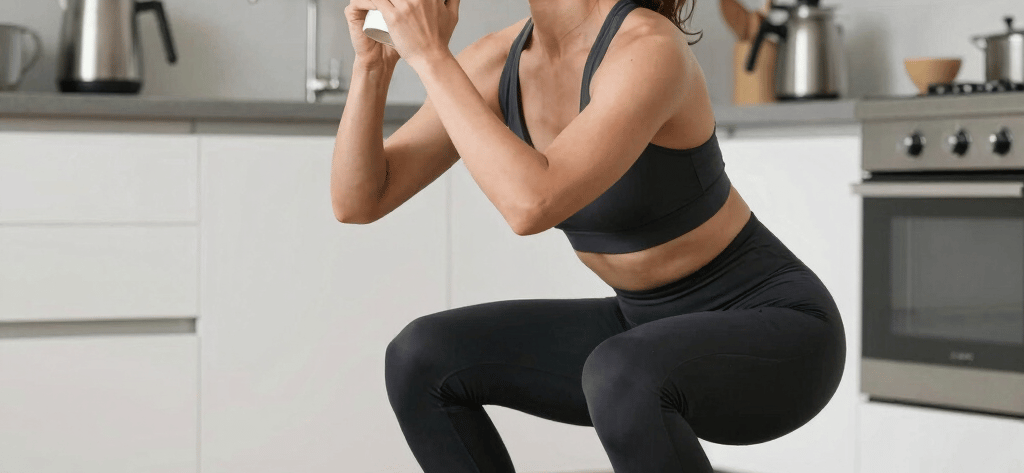
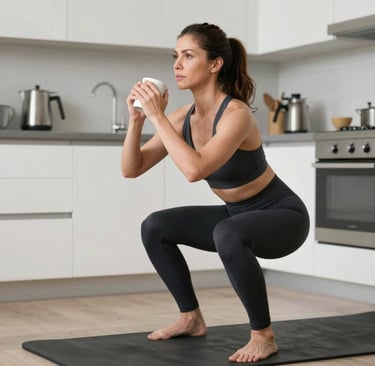
"My coffee brewer takes exactly 4 minutes and 30 seconds. I know this because I started using that time to move. No gym, no equipment, no changing clothes. Just me, my kitchen, and five exercises that changed how I start every single day."
Why "Exercise Snacking" Is the Future of Fitness for Busy Women
Let's be honest: for most moms and busy women, the traditional fitness model is broken. "Go to the gym three times a week for 45 minutes" sounds great in theory, but it requires childcare, a gym bag, a schedule that doesn't get blown up by a sick kid at 2am, and a version of you that isn't already running on fumes before 9am. It's no wonder so many of us start strong in January and quietly stop by March.
Enter exercise snacking — and it's not a fad. It's a legitimate, research-backed approach to movement that fits the way real life actually works. Exercise snacking refers to brief, intentional bouts of movement — typically 2 to 10 minutes — distributed throughout the day rather than consolidated into one long session. Think of it as nibbling on movement instead of trying to sit down for a three-course fitness dinner you'll never finish.
Here's the part that blew my mind when I first read about it: multiple short movement bouts can match or even exceed a single longer gym session for metabolic health outcomes. A landmark study from the University of British Columbia in 2022 found that three 10-minute walks throughout the day improved blood sugar regulation just as effectively as one 30-minute walk. Same total time, dramatically lower barrier to entry.
For busy moms, this is genuinely life-changing information. You don't need a blocked-off gym slot. You need five minutes here, five minutes there, and a method for making those minutes happen reliably. That last part — the reliable habit — is where coffee comes in.
The physiological case for exercise snacking is solid. Even 60-second movement bouts have been shown to meaningfully reduce the negative effects of sedentary time on blood sugar and cardiovascular markers. Every time you break up a stretch of sitting with movement, you're prompting your muscles to take up glucose from the bloodstream, reducing the burden on your pancreas and improving insulin sensitivity. You're nudging your heart rate up, increasing circulation, and releasing mood-boosting neurochemicals. You're doing something real — in the time it takes your coffee to brew.
The Science of Habit Stacking
Here's where the rubber meets the road. Knowing that short exercise bouts are good for you is one thing. Actually doing them every single morning is another. That's where behavioral science gives us a powerful tool: habit stacking.
Two of the most influential books on behavior change — BJ Fogg's Tiny Habits and James Clear's Atomic Habits — arrive at the same core insight from different research angles. New habits are most effectively established not by willpower or motivation (both of which are unreliable and deplete), but by anchoring them to existing automatic behaviors that already have strong neural pathways.
Your brain already has a deeply grooved routine: you walk to the kitchen, you start the coffee maker, you wait, you pour. That sequence runs on near-autopilot. There's no decision involved. The neural pathway is so well-established that you could probably do it half-asleep — and let's be real, many of us do.
When you insert a new behavior — like five exercises — into that existing window, you are not starting a new habit from scratch. You are inserting behavior into an existing ritual. The cognitive overhead drops to nearly zero. There's no scheduling, no willpower required to decide to exercise today. Coffee starts, I move. It's almost binary.
I want to be transparent with you: I've done this for 14 months straight. Not because I'm unusually disciplined. In fact, I'm the opposite — I'm a scheduler who hates schedules, a mom who barely remembers what day it is half the time. It works because I'm not asking my brain to do something new. I'm asking it to do something slightly different during a window it already owns. That's the whole game.
The formula James Clear describes is: After [CURRENT HABIT], I will [NEW HABIT]. In our case: "After I start my coffee maker, I will do my five exercises until it's done brewing." Write it down on a sticky note. Put it on your coffee maker. Seriously — that sticky note is more powerful than any fitness app I've ever downloaded.
Exercise 1: Bodyweight Squats
Legs & GlutesCore☕ 3 sets of 10
If I could only do one exercise for the rest of my life, it would be a squat. No single movement works more muscle at once, and no movement is more directly applicable to everyday mom-life.
Proper Form
Stand with feet hip-width apart, toes pointing slightly outward — about 10 to 15 degrees
Keep your chest tall and your gaze forward — resist the urge to look down at the floor
Brace your core gently, as if bracing for a light punch to the stomach
Lower yourself by pushing your knees out in line with your toes — imagine you're sitting back into a chair placed behind you
Aim to get your thighs parallel to the floor, or as close as comfortable for your current mobility
Drive through your heels to stand back up, squeezing your glutes firmly at the top of each rep
Muscles worked: Quadriceps, glutes, hamstrings, and core stabilizers — the four largest muscle groups in your lower body, all activated simultaneously in one movement.
Beginner modification: Place a sturdy chair behind you and squat to gently touch the seat before standing back up. This gives you a depth target and removes any fear of losing balance backward.
Advanced variation: Add a 2-second pause at the bottom of each rep. That pause eliminates momentum and forces your muscles to do all the work. You will feel the difference immediately — and your legs will too.
Why squats matter for you specifically: Squats activate the largest muscle groups in the body, which means they burn more calories per rep than almost any other exercise. But more practically — squats build the exact strength you use every single day: picking up a toddler, lugging groceries from the car, getting up off the floor after playtime, or simply navigating a day that requires your legs to hold you up through exhaustion. This is functional strength in its purest form.
Exercise 2: Wall Push-Ups (or Floor Push-Ups)
ChestShouldersTriceps☕ 2 sets of 12-15
Upper body strength is the most commonly neglected area in women's fitness. We focus on glutes, legs, and "toning," but genuine pushing strength — the ability to press weight away from your body — matters enormously for posture, injury prevention, and day-to-day function. Push-ups build that strength with zero equipment and total scalability.
Wall Push-Up Form
Stand an arm's length from a wall, feet hip-width apart
Place your hands flat on the wall at shoulder height and shoulder-width apart, or slightly wider
Keep your body in a straight line from your heels to the top of your head — no sagging hips, no raised rear
Slowly lower your chest toward the wall by bending your elbows, keeping them at about a 45-degree angle from your torso, not flared straight out to the sides
Press firmly back to the starting position, feeling the effort through your chest and arms
Floor Push-Up Form
Hands slightly wider than shoulder-width, fingers spread for stability and wrist comfort
Body forms a straight plank — tight core, neutral spine, feet together or hip-width apart
Lower your chest to within an inch of the floor, elbows tracking at that 45-degree angle
Press powerfully back to the start position, exhaling on the way up
Muscles worked: Pectorals (chest), deltoids (shoulders), triceps, and the core stabilizers that keep your body aligned throughout the entire movement.
Progression bridge: If wall push-ups feel easy but floor push-ups feel impossible, try an incline push-up with your hands on a kitchen counter or sturdy table. Lower the surface height gradually as you get stronger until you are comfortably on the floor.
Why this matters: Beyond aesthetic benefits, improved posture from push-up training directly reduces the neck and shoulder pain that comes from hunching over a phone, leaning over children, or sitting at a desk for hours. Strong pushing muscles support your shoulder joints in ways that prevent common injuries. And honestly? Being able to do a proper floor push-up is one of the most quietly empowering physical milestones you'll reach this year.
Exercise 3: Glute Bridges
GlutesHamstringsLower Back☕ 2 sets of 15
Yes, I do these on the kitchen floor. In pajamas. With my coffee maker gurgling two feet away. There is absolutely no shame in this, and I say that as someone who once felt like "real" exercise required matching workout sets and a gym playlist. Real exercise is whatever gets done.
Proper Form
Lie on your back on the floor with your knees bent, feet flat, and feet about hip-width apart
Arms rest at your sides with palms down for stability and grounding
Press your lower back gently into the floor, then drive your hips toward the ceiling by squeezing your glutes powerfully
At the top, your body should form a straight diagonal line from your shoulders to your knees — avoid overarching through your lower back
Pause for one full second at the top, really squeezing your glutes — this pause is where the magic happens, so do not skip it
Lower your hips slowly and with control back to the floor, resisting gravity on the way down
Muscles worked: Gluteus maximus as the primary mover, plus hamstrings, lower back extensors, and core stabilizers — the entire posterior chain that keeps you upright, pain-free, and functional throughout a long day.
Ready for more challenge? Try the single-leg bridge: extend one leg straight out, press up on the other planted leg. This dramatically increases the demand on each glute individually and also challenges hip stability. Perform 10 reps per leg instead of 15 bilateral reps.
Why this matters: Most of us have glutes that are functionally "asleep" from hours of sitting — a phenomenon researchers actually call gluteal amnesia. When your glutes don't fire properly, your lower back picks up the slack. This is one of the most common drivers of the chronic lower back pain that plagues busy moms. Glute bridges wake those muscles back up, strengthen your posterior chain, and protect your spine during every lifting movement you perform throughout the day — including hoisting 25 pounds of wriggling, laughing toddler.
☕
Time It
Use your phone's stopwatch. Most coffee takes 4-5 minutes. That's 2-3 exercises perfectly timed. Knowing the window is finite makes it dramatically easier to start.
🧶
No Shoes Needed
Do this in socks or barefoot. Removing the friction of workout gear removes excuses. You are completely ready exactly as you are, the moment you wake up.
📋
Post a Reminder
Put a sticky note on your coffee maker: "MOVE WHILE IT BREWS." You'll smile, then squat. Low-tech works best. Don't overthink the system.
📈
Progressive Overload
Each week, add 2 reps per set. In 6 weeks you'll be noticeably stronger. The magic is in the compound effect — small daily steps, remarkable transformation.
11 min
Just 11 minutes of moderate movement per day — the length of 2-3 coffee-brewer exercise sets — is associated with a 17% lower risk of all-cause mortality, according to a 2023 British Journal of Sports Medicine meta-analysis covering over 196 peer-reviewed studies and nearly 45,000 participants. You do not need more time. You need more consistency.
Exercise 4: Standing Calf Raises
CalvesCirculation☕ 1 set of 20-30 reps
This one feels almost too simple — and that's exactly why it's so easy to do every single morning without dread. Calf raises are the kind of exercise you can perform while holding your coffee mug, staring out the window, watching the sunrise slowly light up your backyard. They are gentle, genuinely effective, and wildly underrated in most home workout routines.
Proper Form
Stand near the kitchen counter with light fingertip support for balance — or, if you're feeling bold, hold your empty coffee mug for a delightful sense of purpose
Feet hip-width apart, toes pointing forward or very slightly outward
Rise up slowly and deliberately onto the balls of both feet, lifting your heels as high as they will comfortably go
Pause at the top for one full beat — feel the squeeze and contraction through the entire calf
Lower back down slowly and with intention — the downward phase is where much of the strengthening benefit lives, so resist the temptation to drop quickly
Aim for 20 to 30 slow, controlled reps rather than fast bouncy repetitions that rely on momentum
Muscles worked: The gastrocnemius (the larger, more visible calf muscle that gives the leg its shape) and the soleus (the deeper, flatter stabilizing muscle beneath it). Together, they are essential for walking, running, climbing stairs, and standing comfortably for long stretches throughout the day.
Ready to progress? Try single-leg calf raises — hold the counter lightly with one hand, lift one foot slightly off the ground, and rise up on the standing leg only. This approximately doubles the load per calf and quickly exposes any strength asymmetry between your left and right side. Start with 10 to 15 reps per leg and build from there.
Why this matters — the "second heart" connection: Fitness professionals and physiologists sometimes call the calf muscles your "second heart," and for very good reason. Every time your calves contract, they actively pump venous blood upward from your lower legs back toward your heart — working against gravity in a way your cardiovascular system genuinely relies on throughout the day. This matters especially if you spend most of your day either sitting (which slows venous return significantly) or standing in one place for long periods (which causes blood to pool in the lower legs). Calf raises in the morning are a literal jump-start for your circulatory system before your day has even properly begun.
Exercise 5: Standing Oblique Crunches
ObliquesCoreHip Flexors☕ 20 alternating reps
This is the one that surprises people most. When I tell other moms I'm training my side core while standing in the kitchen in my pajamas, they give me a look that suggests I've said something eccentric. Then I show them and they immediately feel the burn and quietly reconsider their skepticism. Standing oblique crunches are effective, require zero floor space, and take about 45 seconds to complete a meaningful set.
Proper Form
Stand with feet hip-width apart, core gently braced and engaged
Place both hands lightly behind your head, elbows wide out to the sides — resist the urge to lace your fingers and pull on your neck
Lift your right knee up and to the right while simultaneously crunching your right elbow down toward that knee
The movement is a lateral compression — you are shortening the right side of your torso and feeling the squeeze in your oblique
Lower your right foot back to the floor with control, then repeat on the left side
Alternate for 20 total reps — 10 per side — focusing on the crunch occurring in your waist rather than just your knee rising high
Muscles worked: External and internal obliques as the primary movers, hip flexors to lift the knee, and the gluteus medius for hip stability during the brief single-leg balance at the top of each rep.
Add a challenge: Pause and hold your knee at the top for 2 seconds before lowering. This turns each rep into a brief single-leg balance challenge on top of the oblique crunch, adding meaningful core stability work. You'll notice increased engagement and a slightly elevated heart rate almost immediately.
Why rotational core strength matters for mom-life: The obliques are responsible for rotational and lateral movement — bending sideways, twisting your torso, and reaching across your body. This matters enormously in practical daily terms: twisting around to buckle a car seat while your arm is at an awkward angle, reaching across your body into the back seat, turning quickly to catch a falling toddler, hauling a laundry basket around a tight corner, or reaching overhead in the pantry while holding something in the other hand. These muscles are constantly recruited in real life and almost never intentionally trained. This exercise starts to close that gap in 45 seconds a day.
How to Build From Here
One of the things I wish someone had told me when I was first starting out is that the goal of any new movement habit is not just the physical result — it's the identity shift. Every morning you do these exercises, you're quietly proving to yourself that you are someone who moves. That evidence accumulates day after day. After six weeks, the statement "I'm someone who doesn't exercise" simply isn't true anymore, and your brain knows it.
Weeks 1–2
Just the 5 exercises, coffee time only. Do not add anything else. Do not optimize the routine. Just show up every morning and move through the sequence. The goal at this stage is completion, not perfection. Do them even if you do them sloppily. Do them even if you skip one exercise. Consistency matters infinitely more than quality right now.
Weeks 3–4
Add 2 reps to each set. If you were doing 10 squats, do 12. If you were doing 15 glute bridges, do 17. This small increment is meaningful because it applies the principle of progressive overload — your muscles adapt and grow only when given slightly more than they've handled before. Also consider whether you have another natural "waiting window" later in the day. Evening tea? Microwave time? Even a second 5-minute session doubles your total weekly movement volume with minimal scheduling burden.
Weeks 5–6
Consider adding a sixth exercise to the rotation — standing hip circles, a plank hold for 20-30 seconds, or tricep dips on the kitchen counter all work beautifully. You might also use one weekend morning for a slightly longer 10-minute bodyweight circuit. By this point the habit is fairly solid. You are not deciding whether to exercise in the morning anymore — you are simply doing it, the same automatic way you are simply making coffee.
Month 2+
You now have a movement foundation. Something important has shifted that goes beyond fitness: you are not someone who does not exercise. You exercise daily. That identity change is worth more than any specific fitness milestone, because it determines what you do when life gets hard, when routines get disrupted, and when motivation disappears entirely. The habit carries you through in those moments in a way that willpower and motivation simply cannot.
The identity shift matters as much as the physical changes — arguably more. When your self-concept genuinely includes "I'm someone who moves every morning," you begin making different micro-decisions throughout the entire rest of your day: you take the stairs, you walk to the corner, you stretch during a phone call. The morning habit radiates outward in ways that quietly compound.
What Happens to Your Body When You Move Daily
I want to give you a real picture of what is actually happening physiologically when you do these exercises consistently. Not to overwhelm you with science, but because understanding the why makes the doing so much more sustainable over time.
⚡
Mitochondrial Density Increases
Even brief exercise bouts stimulate mitochondrial biogenesis — the creation of new cellular power plants in your muscle cells. More mitochondria means your muscles become progressively more metabolically efficient over weeks of consistent training.
🧠
Insulin Sensitivity Improves
Movement causes muscles to take up glucose from the bloodstream independently of insulin. Even a short morning movement session can improve blood sugar regulation for hours afterward — a benefit that compounds significantly when practiced daily over months.
🧠
Mood-Boosting Neurochemicals Spike
Exercise triggers the release of dopamine, serotonin, and BDNF (brain-derived neurotrophic factor — sometimes called "Miracle-Gro for the brain"). These elevate mood, sharpen focus, and build long-term brain resilience. Most people notice the mood lift within the very first week.
🌙
Sleep Quality Improves
Regular morning movement helps regulate your circadian rhythm by signaling to your body that it is time to be awake and active. This produces a corresponding improvement in nighttime sleep quality over 4-6 weeks — a genuinely massive quality-of-life win for exhausted moms.
🔥
Resting Metabolism Rises
Muscle tissue is metabolically active, meaning it burns calories even at rest. As you build strength through consistent training, your resting metabolic rate gradually increases. This effect is modest but real, and it compounds meaningfully over months of sustained training.
⚙️
Daily Energy Levels Stabilize
Counter-intuitively, expending energy in the morning creates more energy throughout the day. Exercise improves cardiac output, oxygen delivery to tissues, and mitochondrial efficiency — meaning your body runs more powerfully and efficiently from the same fuel input by afternoon.
Making It Stick: The Mindset Component
I want to talk about something that doesn't get nearly enough airtime in fitness content: the mental game of building a daily movement habit. Specifically, how most conventional fitness advice sets us up to quit by creating unrealistically high standards for what counts as success.
"Lower the bar so far that success is almost unavoidable. 'I just need to make coffee and do squats.' That is the entire standard for this morning. Nothing more is required of me."
That's it. That is the mindset shift that makes this sustainable for months and years rather than weeks. You are not training for a 5K. You are not "getting in shape by summer." You are making coffee and doing squats. That framing feels almost embarrassingly modest — and that's precisely why it works. When the bar is that low, you almost never miss. And when you almost never miss, the habit takes root deeply and becomes part of who you are.
Celebrate completion, not performance. The squat form does not need to be perfect. The reps do not need to be exactly the right number. The exercise does not need to feel hard or challenging. What matters is that you moved your body intentionally this morning. Every single morning you do that, you win. That is worth a quiet internal acknowledgment: I did the thing. That matters.
Missing a day is not failure — it's data. Life happens. Kids get sick at 3am. You oversleep through the alarm. You genuinely forget. The response to a missed day is not self-recrimination, which is both unproductive and exhausting, but honest curiosity: what made it harder yesterday? Was I too tired because I stayed up late? Did I not set up the coffee maker the night before? What friction can I remove so tomorrow is easier? Adjust and move on. Missing one day in a habit you've done 40 times is a data point, not a failure.
Expect automaticity around weeks 6-8. Research on habit formation suggests that many moderate-effort behaviors become reliably automatic in the 60-90 day range. The widely repeated "21 days to build a habit" claim has been thoroughly debunked — it's closer to 66 days on average for moderate habits, according to a 2010 longitudinal study by Phillippa Lally at University College London. If you can push through to that 6-8 week mark, something genuinely shifts. You will start to feel wrong when you don't move while the coffee brews. That feeling of wrongness is your new identity kicking in — and it is the most reliable fitness tool you will ever develop.
Frequently Asked Questions
Is 5 minutes of exercise really enough to make a difference?
Yes — especially when you're consistent. A 2022 study in Nature Medicine found that just 4 minutes of vigorous incidental movement per day — things like stair climbing or brisk walking — was associated with a 45% lower risk of cancer in people who were otherwise sedentary. And a 2023 meta-analysis in the British Journal of Sports Medicine found that 11 daily minutes of moderate movement significantly reduces cardiovascular mortality risk.
The key insight is that consistency over months and years matters far more than intensity in any single session. These 5 exercises done daily compound into meaningful strength, metabolic, and health improvements over 30 to 60 days of consistent practice. The science on this point is unambiguous: some daily movement is dramatically better than none, and regular short bouts consistently outperform sporadic longer sessions for real-world health outcomes in sedentary populations.
Can I lose weight just doing these exercises?
The primary benefit of this routine is building a sustainable movement habit, improving functional strength, and boosting metabolic health — not acute calorie burning in any single session. Five minutes of exercise burns approximately 30 to 60 calories depending on body weight and intensity, which is meaningful but will not drive significant fat loss on its own.
However, consistent daily movement contributes to fat loss indirectly in several important ways: it gradually raises your resting metabolic rate as you build muscle tissue over time, it improves insulin sensitivity which reduces fat storage, and it improves energy levels throughout the day so you naturally move more even outside of your intentional exercise window. Pair these exercises with thoughtful nutrition — particularly adequate protein intake to support muscle building — and you will see meaningful body composition changes within 6 to 8 weeks. Think of this routine as the foundation of a healthier, more active identity rather than as a complete weight loss program in itself.
Do bodyweight exercises build real muscle?
Yes — bodyweight exercises absolutely build muscle, especially for beginners and intermediate exercisers who have not been training consistently. Squats, push-ups, and glute bridges are compound movements that recruit multiple muscle groups simultaneously, generating significant mechanical tension in the muscle fibers — which is the primary driver of muscle hypertrophy regardless of whether the resistance comes from a barbell or your own bodyweight.
Progressive overload — gradually adding reps, slowing the tempo, increasing the range of motion, or moving to more challenging exercise variations — ensures continued muscle adaptation even without added weight. A 2022 systematic review in the Journal of Human Kinetics confirmed that bodyweight training produces similar muscle hypertrophy outcomes to resistance training with weights when matched for intensity and volume. The key is progressing over time rather than doing the same 10 reps forever and expecting continued results.
What if I don't drink coffee — can I still use this method?
Absolutely. The coffee-brewer is just the anchor habit in this particular system — any consistent daily activity that includes a natural built-in waiting period can serve exactly the same neurological purpose. Some excellent alternatives that work beautifully: while the kettle boils for tea (typically 3-4 minutes at a full boil), while your oatmeal or eggs cook on the stovetop, while your kids' breakfast toasts, while the shower heats up to your preferred temperature, or while your computer and applications load up in the morning.
The underlying neurological principle is identical regardless of which anchor you choose: attach the new behavior to an existing automatic habit that already runs on autopilot without requiring a decision. Once you identify your personal daily anchor, the exercises lock in remarkably quickly. Many readers who don't drink coffee have told me that "while the shower heats up" works especially well — partly because it ensures they cannot skip the exercises without also skipping the shower, which turns out to be a very effective personal accountability mechanism.
How do I progress once these exercises get too easy?
Getting to the point where these exercises feel easy is an excellent problem to have — it means the habit is working and your body is genuinely adapting. Here is the complete progression pathway for each exercise in the routine:
Squats: Sumo squats with a wider stance and toes turned far out, then pause squats with a 2-second hold at the bottom, then jump squats for power development, then Bulgarian split squats with your rear foot elevated on a chair for single-leg strength.
Push-ups: Decline push-ups with feet elevated on a chair to shift load toward the upper chest and shoulders, then diamond push-ups with hands close together for tricep emphasis, then archer push-ups where one arm extends wide while the other bends — a true intermediate challenge.
Glute bridges: Single-leg glute bridges, then hip thrusts with your shoulders elevated on a chair or couch for a greater range of motion and deeper glute activation.
Calf raises: Single-leg calf raises on one foot, then add resistance by holding a water bottle or heavy book in the same-side hand.
Oblique crunches: Add a 2-second lateral hold pause at the top of each rep. You can also simply increase total reps, add a third set, slow your tempo to 3 seconds down and 1 second up, or add a second movement window later in your day.
Is it safe to exercise on an empty stomach in the morning?
For most healthy women, exercising fasted in the morning is perfectly safe and even has some research-supported benefits. Some studies suggest that fasted low-to-moderate intensity exercise increases the proportion of fat used as fuel during the session, which can be favorable for body composition goals. For a 4-5 minute sequence of bodyweight exercises at moderate intensity, the total energy demands are modest enough that blood sugar status is rarely a meaningful limiting factor for healthy adults.
If you experience dizziness, lightheadedness, nausea, or significant weakness during morning fasted exercise, that is your body's signal to have a small snack first. A banana, a small handful of nuts, a few crackers, or even a tablespoon of peanut butter can raise blood sugar sufficiently to make morning exercise comfortable without requiring a full meal or significant digestion time beforehand.
Important caveats that should not be overlooked: if you are pregnant, have type 1 or type 2 diabetes, have a medical condition that affects blood sugar regulation or cardiovascular function, or are on medications that influence blood glucose levels or heart rate, please consult your healthcare provider before exercising in a fasted state. This general guidance is intended for healthy adults and should not override personalized medical advice from a qualified professional who knows your individual health history.
Copyright © 2026 Health & Fitness with Ella. All rights reserved.